



 30-DAY MONEY-BACK GUARANTEE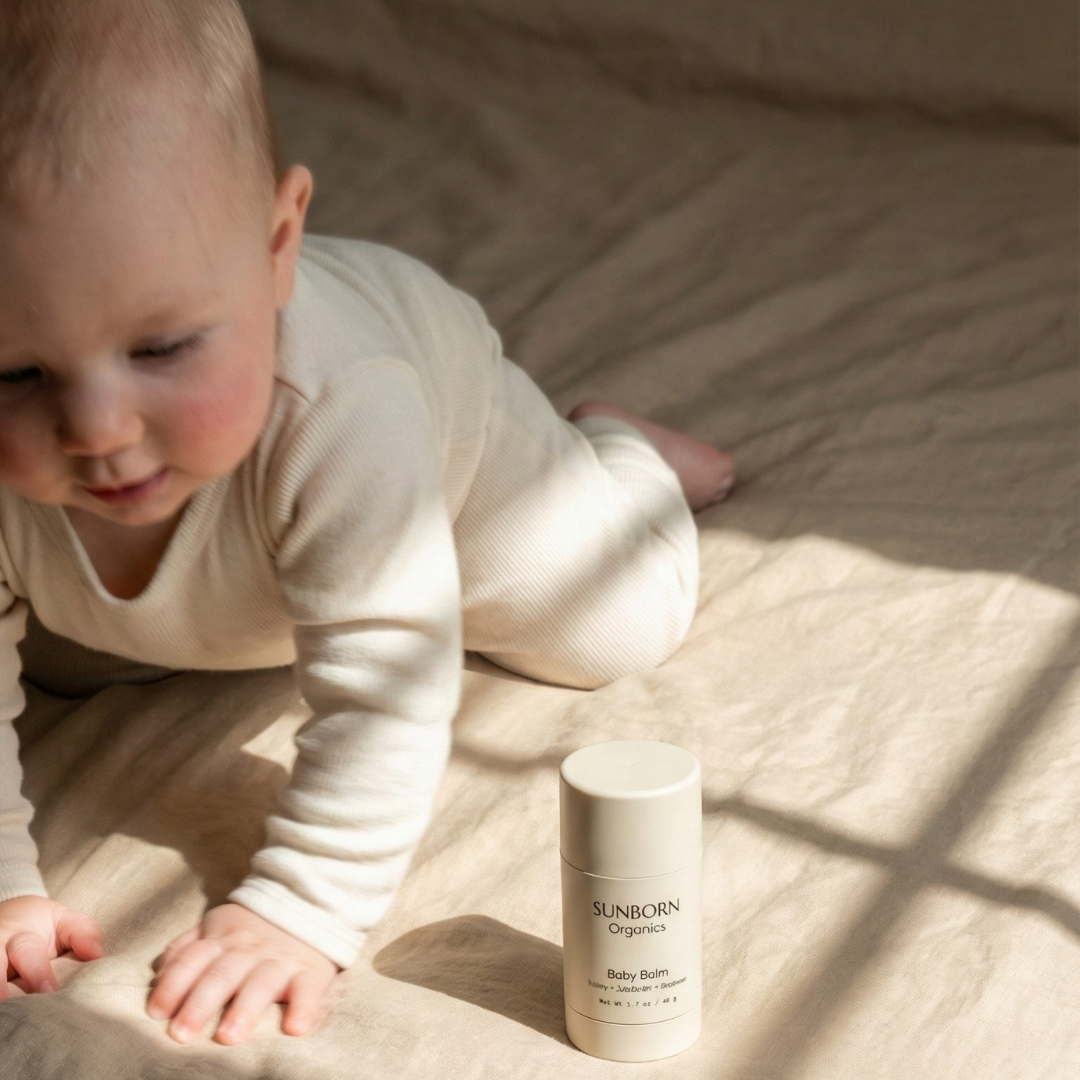
Baby Skincare Routine: A Simple, Barrier First Approach With Baby Balm
Key Takeaways
-
Baby skin is thinner, more permeable, and still developing its protective barrier. This makes gentle, minimal care essential (not optional).
-
Many conventional baby products contain long ingredient lists, added fragrance, and petroleum derivatives that can irritate sensitive and eczema prone skin.
-
A barrier first routine focuses on gentle cleansing and consistent moisturizing with fewer ingredients and fewer triggers.
-
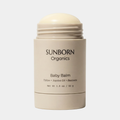
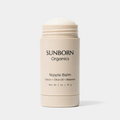
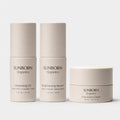
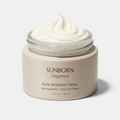
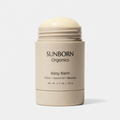
Sunborn Baby Balm contains just three ingredients, has no fragrance, and is third party lab tested for purity. Because your baby deserves simplicity you can trust.
Have you ever stood in the baby aisle, staring at rows of lotions, balms, and washes, wondering which one won't make things worse?
You're not alone.
Here's the thing: baby skincare doesn't have to be complicated. In fact, for sensitive and eczema prone skin, less truly is more. We've seen it over and over. Parents adding products, trying new things, hoping something will finally work. When what baby skin actually craves is calm, consistent, barrier first care.
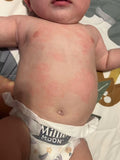
If you've been dealing with eczema flares or persistent dry patches on your little one, we know how exhausting that cycle can be. Trying a new product, hoping this one will work, then watching the redness return. (Sound familiar?)
This guide shares a gentle baby skincare routine that supports the skin barrier, especially for sensitive or eczema prone skin. Plus, we'll explain why ingredient choices matter so much during those precious early months.
Why Baby Skin Is Different (And Why That Matters)
Baby skin isn't just a mini version of adult skin (though wouldn't that be simpler?).
Research shows that neonatal and infant skin is thinner, more permeable, and less developed. This can make it more vulnerable to dryness and irritation. Infant skin barrier properties also continue developing with age, which is one reason many babies have more reactive skin early on.
The goal isn't to do more. It's to do less, better. Support the skin barrier. Reduce potential irritants. Keep routines gentle.
The Hidden Issue With Conventional Baby Skincare
Here's what most baby product brands won't tell you: those formulas are designed for shelf stability and mass market appeal, not for your baby's unique skin.
That often means long ingredient lists, added fragrance, and multiple preservatives. You'll also spot petroleum derived ingredients like petrolatum, mineral oil, and paraffin in most drugstore options. These ingredients are inexpensive, easy to formulate with, and create a coating that reduces moisture loss. But they're not exactly what we'd call skin nourishing.
For babies with sensitive or eczema prone skin, fragrance is a common trigger. Dermatology guidance recommends choosing products labeled "fragrance free" (not just "unscented") to help reduce flare risk.
Let's be real: the more ingredients you apply daily, the more chances there are for irritation. This matters even more when baby skin is still developing its barrier.
Why Less Often Works Better for Sensitive and Eczema Prone Skin
If your baby struggles with dryness, redness, or eczema, it can be tempting to try more products and more steps. We get it. You want to fix it.
But here's what we've learned: a barrier first routine is often about reducing variables. Fewer products can mean fewer ingredients. Fewer ingredients can mean fewer triggers.
Eczema care guidance emphasizes gentle bathing technique and applying a fragrance free moisturizer soon after bathing to help lock in hydration. Simple, consistent, effective.
Our Philosophy: Three Ingredients, Chosen With Intention
We made Sunborn Baby Balm with one guiding principle: include only what baby skin truly needs, and nothing more.
Tallow has been used on skin for generations. Long before the beauty industry decided we needed 47 ingredient formulas. Our grandmothers and great grandmothers understood something we're only now rediscovering: skin recognizes skin compatible fats. Tallow's lipid profile is remarkably similar to the oils our own skin produces, which is why it absorbs so beautifully without clogging pores or sitting on the surface.
Our Baby Balm is minimalist, natural, and fragrance free. It uses a base you can recognize: grass fed, food grade tallow. "Food grade" means it meets standards for purity and handling. It reflects the level of care we bring to ingredient sourcing for babies.
Our Baby Balm has just three ingredients:
-
Grass fed, food grade tallow is a lipid rich base chosen to nourish and support the skin barrier. We source ours from small, regenerative farms with the same quality standards we'd want for our own families.
-
Organic golden jojoba oil is a skin friendly wax ester that helps soften and moisturize without added fragrance or filler ingredients.
-
Organic beeswax is a gentle protectant that helps seal in moisture and support the barrier.
That's it. No fragrance. No masking scent. No preservatives. No fillers. Just three functional ingredients doing exactly what they're meant to do.
Trust matters. Our baby products are third party lab tested for purity, so you can feel confident about what you're putting on your little one's skin.
A Simple Baby Skincare Routine With Baby Balm
Step 1: Cleanse Gently (And Don't Over Bathe)
Here's something that surprises many new parents: most babies don't need daily baths. Pediatric guidance notes that three baths per week during baby's first year may be enough. It also notes that bathing too frequently can actually dry out skin.
Dermatology guidance similarly notes bathing only needs to happen two to three times a week, as long as the diaper area is cleaned well during changes.
A gentle rule of thumb:
Use lukewarm water. Keep baths short. Avoid scrubbing. Choose fragrance free if you use cleanser. Pat skin dry instead of rubbing.
Step 2: Moisturize and Protect
After bath time, while skin is still slightly damp, warm a small amount of Baby Balm between your hands and apply a thin layer.
This step helps lock in moisture, support the skin barrier, and protect against dryness and irritation. Because it's concentrated, a little goes a long way.
Step 3: Use It Daily Where Babies Need It Most
Baby Balm is especially helpful for cheeks and chin (where drool and weather can cause dryness), dry patches, eczema prone areas as gentle barrier support, hands, feet, elbows, and knees. You can also apply it to the outer diaper area skin as needed for protection.
Questions We Hear From Parents
"Can I use this on my newborn?"
Yes! Our Baby Balm is designed to be as newborn friendly as possible. It's fragrance free, preservative free, and made with just three simple natural ingredients.
"Can I use this on my older kids?"
Absolutely can be used for older kids and adults. Our Baby Balm is designed for the most delicate developing skin, so it works for every skin type and every age.
"Will it help with eczema?"
We don't claim to treat or cure eczema. But many families with eczema prone or extra sensitive skin reach for our Baby Balm because it's minimalist, natural, and fragrance free. That means fewer potential irritants while supporting the skin barrier. Barrier first care is a core part of eczema friendly routines.
"How often should I apply it?"
Apply as often as you like, but using it as part of morning and evening routine (after bath when skin is still a little damp) works extremely well to lock in moisture. The convenient hands-free design makes it easy to top up anytime, anywhere, on the go.
"Does it have a scent?"
There's no added scent and no fragrance. Any natural aroma is mild and comes only from the raw ingredients themselves.
A Calmer Approach to Baby Skincare
Parenting comes with enough hard decisions. Your baby's skincare routine doesn't have to be one of them.
When you strip away the unnecessary (the fragrance, the fillers, the 20 ingredient formulas), you're left with what actually matters: gentle protection while that precious skin barrier develops.
If you're looking for a simple, minimalist foundation for your baby's skincare routine, our Baby Balm was created for exactly that purpose.
Trust us, once you simplify, you'll wonder why you ever made it so complicated. ;)
Sources
-
Neonatal and infant skin barrier review, PubMed Central: https://pmc.ncbi.nlm.nih.gov/articles/PMC11791375/
-
Infant skin barrier maturation review, PubMed Central: https://pmc.ncbi.nlm.nih.gov/articles/PMC8880311/
-
American Academy of Dermatology, eczema friendly products and triggers: https://www.aad.org/public/diseases/eczema/childhood/triggers/friendly-products
-
American Academy of Dermatology, treating eczema in babies: https://www.aad.org/public/diseases/eczema/childhood/treating/treat-babies
-
HealthyChildren.org, American Academy of Pediatrics newborn bathing: https://www.healthychildren.org/English/ages-stages/baby/bathing-skin-care/Pages/Bathing-Your-Newborn.aspx
-
American Academy of Dermatology, newborn bathing: https://www.aad.org/public/everyday-care/skin-care-basics/care/newborn-bathing

.%0A%0A%0AMany%20conventional%20baby%20products%20contai...)
Leave a comment
This site is protected by hCaptcha and the hCaptcha Privacy Policy and Terms of Service apply.